
The World, Solo
Going alone. Coming back different.

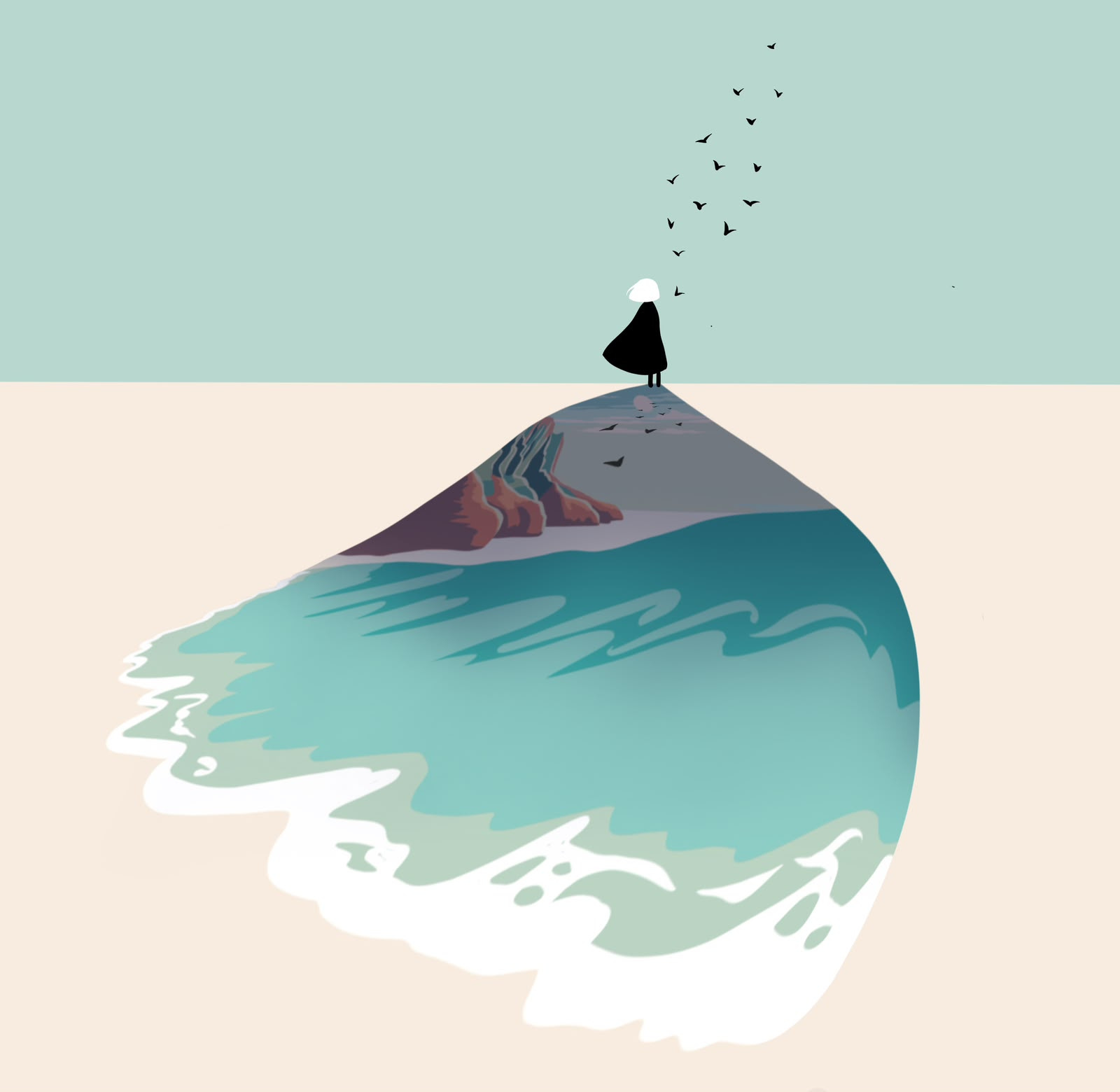
Uncomfortable Visual Expression by Tânia Falcão
There is a look I have learned to recognise.
When I mention that I have travelled alone — that I have done it more than once, that I have sought it out, that I have loved it — most people look at me as if I were a slightly strange creature. Mildly fascinating. Possibly in need of company.
But occasionally — not always, not even often — I see something else. A spark. Quick, quiet, almost suppressed. The look of someone who knows. Lone travellers share a particular kind of silence. They don’t need to explain themselves to each other. They just nod.
When you travel alone you finesse the art of observation. Others’ and yours. And observation, in order to absorb all the nuances of what or whom you are watching, requires silence. Requires space. Requires the particular freedom of having nobody to answer to but yourself.
My first solo
It started in 1986.
I had just begun working in advertising. My wage was higher than average — even for a rookie — and for my first real vacation I decided I wanted to go to the United States. Not only New York. I wanted to travel the country.
I had travelled through Europe with a friend before and remembered it with a bitter feeling — she was dependent, not very curious, and relied on me for almost everything. That trip, and others like it, had left me with a quiet realisation: travelling with others is not easy. Not because people are bad company. But because the wrong company makes you smaller than you are.
So I decided to go alone. For an entire month.
There were no mobile phones in 1986. My mother was a little worried. But she trusted me — and with the promise that I would call every two or three days, proud of myself and slightly terrified, I left.
That trip opened a door I have never closed.
Extraordinary things have happened to me while travelling solo.
Some were frightening — the unexpected has a sharper edge when there is nobody beside you to look at. You develop a sixth sense of protection about places and people. Streets you don’t dare enter, not because of any visible reason but because your instinct says so. People you avoid because your body knows before your mind does.
A man who follows you on a street saying things you don’t want to hear. Another who tries to take your bag. Your heart pounds and you arrive at your destination with cortisol levels that make your hands shake. But you are alive. So alive it almost hurts your veins. And then, later, you write it in your diary and somehow it becomes an adventure rather than a threat.
There are moments of loneliness too. The particular ache of wanting to show someone something beautiful and having no one there. But then you look at your diary — cover bent from use, filled with notes and small souvenirs — and you remember how free you are. How able to change direction at will. And the ache simply goes away.
And then there are the other moments.
The inexplicably beautiful ones.
Amtrak, travelling south across the United States through the cotton fields.
The train moves beside them and you watch the bolls floating like snowflakes. You lose the sense of time and space completely — everything slows down, like a film finding its perfect frame. You press your face against the window glass and although it is warm the cotton looks like ice. Unconsciously you press your tongue to the glass expecting it to freeze and stick. Someone working in the field waves. And you know — you simply know — that the wave is for you.
United Airlines, flying to San Francisco.
You are annoyed because your seat is in the middle of one of those centre rows with six places. You are in the second seat, just one between you and the aisle. A tall woman approaches — a banana in one hand, an orange backpack on her shoulder, a beautiful hat in the other. She puts her bag in the overhead compartment and sits next to you. You immediately like her face. She peels the banana and says: Would you like some?
You talk for the entire flight. No sleep, no films, just fruit and conversation. She is half Chilean, half French, many years in the United States, working in high fashion photography. Drugs, burnout, la vida loca — and then the discovery that she had glass bones, a severe prognosis she had defied with slow yoga. Upon arrival you both make promises to keep in touch that you both know, in that particular way, will never happen. Except for the memory. Which will stay for life.
Miami, Florida.
You are exhausted after a very hard year. The Delano has just opened and you book it. They take you to your room. The door opens and the white of everything is so pristine that your white T-shirt seems dirty. You feel the most profound peace in all that whiteness — the warm ocean breeze floating the curtains. You shower, moisturise slowly, lie on the bed.
And then you notice it. A single green detail: a Granny Smith apple. And on the wall beside it, a small sentence:
Food for thought.
You smile. The Garden of Eden, here, in this perfect white room. A tiny note of sin to bring you back to earth.
Budapest.
You arrive early at the Gellert — the extraordinary 1918 Art Nouveau hotel, famous for its thermal pool. You go before anyone else. The place is empty. You submerge yourself in the warm water and watch the columns reflected on the surface. Just water and silence and the vague, impossible sensation of going back to the glorious 1920s.
Istanbul.
You walk until you find the view of the Bosphorus you have been looking for. You get there and you become speechless.
This feels like home.
A child passes, stops, stares at you with complete curiosity and offers you a flower.

I could go on. But I think the ache of it would become unbearable — it has been a long time since I last travelled alone, and writing this I feel the pull of it like a tide.
Solo travel is one of the most profound things you can do if you truly want to know yourself. Not because it strips you of comfort — though it does. But because without the noise of other people’s needs and opinions, you finally hear what you actually think. What you actually feel. Who you actually are when nobody is watching.
And here is the thing nobody tells you about travelling alone: it is the least lonely way to travel.
Because when you are open — truly open, undefended, unhurried — the world sends people to you. Not all of them stay. Most of them don’t. But some of them become the kind of friends that thirty years cannot diminish.
The love of the world is something you can give away without losing any of it.
The least lonely way to travel
When my children were small we played a game. Eyes closed, we would open the atlas at random and point — still without looking — to a country. Then whoever opened their eyes first had to give clues: the borders, the neighbouring countries, something about the culture, the landscape, the people. The others had to guess.
I never told them I was teaching them anything. I was just playing.
But I think what I was really doing was showing them the same thing the world had shown me: that not knowing where you are is not frightening. It is the beginning.
My dear Margie Doorman was found in New York, more than thirty years ago. An Australian woman who had sold everything she owned to travel the world — because some people understand, before the rest of us, that the world is worth more than the things you accumulate in it. We made the kind of connection that needs no maintenance — the kind that simply picks up, wherever it was left, without effort or explanation. She came to visit in 2024 and within ten minutes we were laughing at the same things, sharing everything that had happened in the years between.
The years had passed. The friendship had stayed untouched.
That is what the world gives you when you travel alone. Not safety. Not comfort. Not the reassurance of a familiar face.
Something better.
The proof that you can trust it. And, in that process, that you can fully trust you.
A note on the essential companions:
The diary is not optional. It is the whole point.
Here are my favourite ones together with what is needed to fill them up with beautiful memories and thoughts:
Notebooks:
Moleskine — the soft cover bullet journal. Lighter than the hard cover, less precious, more willing to be bent and filled and carried everywhere. The one that looks used is the one that did its job.
Mishmash — a Portuguese brand born from a grandfather’s stationery shop in Porto, where the scent of paper was part of every childhood morning. Minimalist, beautifully made, sustainably produced. The kind of notebook that makes you want to write something worthy of it.
Liberty’s — for when you want the cover to be as beautiful as what’s inside.
Pens:
Muji — bring a black, a blue, and at least five colours. You will use all of them.
Kaweco — the compact German pen, founded in 1883, that fits in a pocket and writes like a promise. One of the most perfect travelling objects ever made.
Pack these. The world will do the rest.